Business Energy Renewals: When Should You Lock In Rates Before Winter?
For many UK businesses, energy costs become a bigger concern as winter approaches.
Demand usually increases, heating and lighting usage can rise, and the energy market can become more sensitive to wholesale price movements, supplier pricing changes and wider global events.
If your electricity or gas contract ends between September and December, it is worth reviewing your renewal well before winter arrives.
That does not mean you need to rush into the first price you see. It simply means you give yourself enough time to compare the market properly, avoid last-minute decisions and secure a fair deal before your current contract ends.
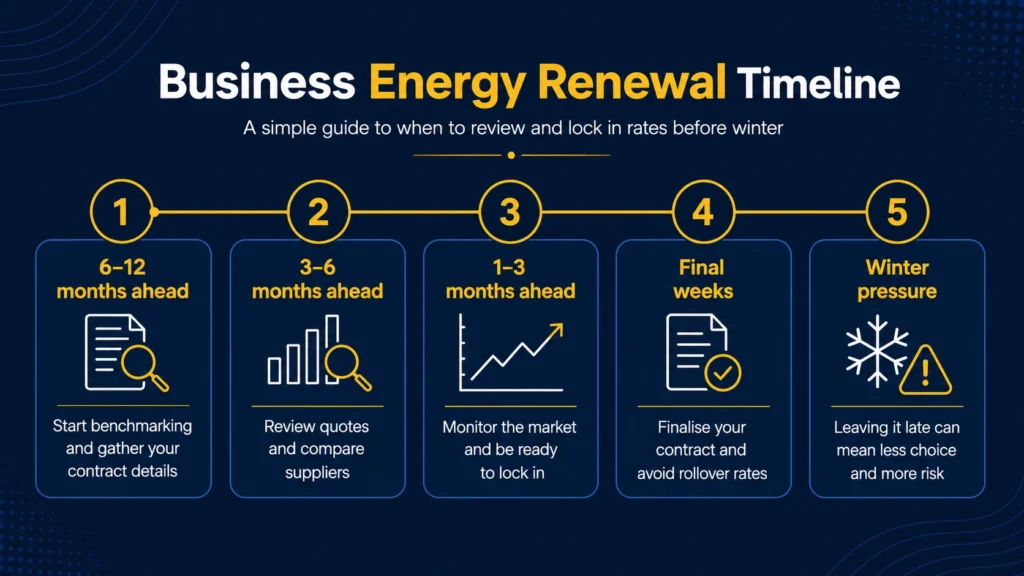
At WeSave, we often speak to businesses that have left their renewal until the final few weeks. By that point, there may be fewer options available, quote validity can be shorter, and there is a greater risk of being moved onto out-of-contract or deemed rates.
The earlier you review, the more control you have.
When should you start reviewing your business energy contract?
As a general rule, businesses should start reviewing their electricity or gas contract several months before the renewal date.
For many standard business meters, reviewing around three to six months before the contract end date is sensible. In some cases, businesses can secure new rates up to 12 months in advance, depending on the supplier, meter type and contract position.
This does not mean you always need to sign a new contract straight away. It means you can start benchmarking your current renewal against live market prices and make a more informed decision.
| Contract end date |
Suggested review period |
| September |
May to June |
| October |
June to July |
| November |
June to August |
| December |
July to September |
| January to March |
6 to 12 months ahead where possible |
For businesses with contracts ending in autumn or early winter, late spring and early summer can be a particularly useful time to start reviewing the market.
It gives you time to compare prices calmly, check your renewal quote properly, and avoid being forced into a rushed decision as winter approaches.
Why timing matters before winter
Business energy prices can move quickly.
Wholesale energy markets are influenced by a range of factors, including demand, storage levels, weather forecasts, global events, supply concerns and wider market sentiment. As winter approaches, these factors can have a bigger impact because energy demand is typically higher.
If the market becomes more volatile, suppliers may shorten quote validity, adjust pricing more frequently or become more selective about the types of contracts they are willing to offer.
This is one reason why leaving your renewal too late can be risky.
It is not just about trying to secure the lowest possible unit rate. It is about managing risk, keeping control of your budget and making sure you have enough time to compare the options properly.
What happens if you leave your renewal too late?
If your business energy contract ends and you do not have a new agreement in place, your supplier may move you onto out-of-contract, deemed or rollover rates.
These are often more expensive than negotiated fixed-term contracts and can make budgeting more difficult.
Leaving your renewal too late can also mean:
- Less time to compare suppliers
- Less time to challenge your renewal quote
- Shorter quote validity periods
- Fewer contract options
- Greater risk of moving onto higher default rates
- More pressure to make a quick decision
Starting early gives you more breathing space.
It allows you to compare your renewal against the wider market, review different contract lengths and decide whether fixing now is the right option for your business.
Should you accept your supplier’s renewal offer?
Not without checking the market first.
Your existing supplier may send you a renewal quote before your contract ends. This can be convenient, but it does not automatically mean it is the most competitive option available.
Many businesses accept renewal offers because they are easy to agree to, not because they have been properly benchmarked.
Before accepting a renewal quote, it is worth comparing:
| What to compare |
Why it matters |
| Unit rate |
This is usually the biggest part of your bill. |
| Standing charge |
Can vary significantly between suppliers. |
| Contract length |
A one-year, two-year and three-year deal can all price differently. |
| Total annual cost |
The clearest way to compare quotes properly. |
| Payment terms |
Some suppliers price differently depending on how you pay. |
| Green energy options |
Renewable electricity or green gas may be available. |
| Contract terms |
Notice periods, renewal terms and billing arrangements all matter. |
At WeSave, we compare your renewal quote against live supplier prices so you can see whether it is genuinely competitive.
If we can beat it, we will show you clearly.
If your existing renewal is already strong, we will tell you.
Fixed tariffs vs pass-through tariffs
When reviewing your business energy renewal, you may come across different types of contracts.
Two of the most common are fixed tariffs and pass-through tariffs.
You can learn more about different contract types by clicking below:
Business Electricity Tariffs
Business Gas Tariffs
Fixed business energy tariffs
A fixed tariff is usually the preferred option for most small and medium-sized businesses.
With a fixed business energy contract, the supplier bundles most costs into a fixed unit rate and standing charge for the contract term. This gives you more certainty over your energy costs and makes budgeting easier.
Fixed tariffs are often suitable for:
- Shops
- Offices
- Restaurants
- Pubs
- Salons
- Guesthouses
- Small warehouses
- Care homes
- Standard SME premises
The main benefit is predictability.
You know what you are paying per kWh, and your business is protected from certain market movements during the fixed contract period.
Pass-through business energy tariffs
A pass-through tariff is more complex.
With this type of contract, some costs may be fixed, while others are passed through to the customer as they change. This can include certain network, policy or non-commodity charges.
Pass-through contracts are more common for larger users, half-hourly meters and businesses that have the time, data and understanding to manage more complex energy costs.
They can be useful in the right circumstances, but they are not always suitable for smaller businesses that simply want cost certainty.
Pass-through tariffs may suit:
- Half-hourly meters
- High-consumption sites
- Multi-site businesses
- Larger commercial users
- Businesses with energy management support
- Sites that can actively manage demand
For most SMEs, a fixed tariff is usually simpler and easier to manage.
What if prices fall after you lock in?
This is one of the biggest concerns businesses have.
Nobody wants to agree to a contract and then see the market fall afterwards.
That is understandable.
However, energy procurement is not just about trying to guess the lowest point in the market. It is about balancing price, timing, budget certainty and risk.
The question is not only:
“Could prices fall a little further?”
It is also:
“What would happen if prices rise before my renewal date?”
For many businesses, especially those with tight margins or high energy usage, securing a fair and competitive rate can be more valuable than trying to time the market perfectly.
A good renewal strategy is not about panic-buying. It is about reviewing early, comparing properly and being ready to act when the price is right for your business.
How far in advance can you lock in business energy rates?
In many cases, business energy prices can be secured several months before your current contract ends.
Some suppliers will allow businesses to lock in new rates up to 12 months in advance, although this depends on the supplier, meter type, credit status, contract end date and market conditions.
As a general guide:
| Business type |
Suggested renewal approach |
| Standard SME meter |
Review 3 to 6 months before the contract ends. |
| Seasonal business |
Review earlier to avoid peak trading periods. |
| High-use business |
Review 6 to 12 months ahead where possible. |
| Half-hourly meter |
Start earlier to allow time for data checks and tendering. |
| Multi-site business |
Review early to align contract end dates where possible. |
| Out-of-contract customer |
Act immediately to avoid unnecessary costs. |
There is no perfect day to sign.
The aim is to start early enough that you can compare properly, monitor the market and make a decision before your options become limited.
Should you fix your business energy prices until 2027?
It depends on your business.
A 12-month contract may suit businesses that want flexibility.
A 24-month contract can give a good balance between stability and future flexibility.
A 36-month contract may suit businesses that want longer-term budget certainty, especially if energy costs are a significant part of their overheads.
However, longer contracts are not always the right answer. If prices fall later, you may have less flexibility. If your business is planning to move, reduce usage, expand or change operations, a shorter contract may be more suitable.
At WeSave, we normally compare different contract lengths side by side so you can see how the prices differ.
This could include:
- 12-month pricing
- 24-month pricing
- 36-month pricing
- Fixed options
- Renewable electricity options
- Green gas options
- Pass-through options, where appropriate
The right decision depends on your usage, risk appetite, budget and future plans.
What information do you need for a business energy quote?
To get accurate business energy prices, it helps to have the right information ready.
The main things you will usually need are:
| Information needed |
Why it matters |
| Latest bill |
Shows your meter details, usage and current supplier. |
| Renewal letter |
Helps compare your supplier’s offer against the market. |
| MPAN or MPRN |
Identifies your electricity or gas supply. |
| Contract end date |
Shows when your new contract needs to start. |
| Annual usage |
Helps suppliers price your quote accurately. |
| Site list |
Useful for multi-site businesses. |
| Current rates |
Allows a like-for-like comparison. |
With this information, quotes can usually be produced much faster and with greater accuracy.
If you are unsure where to find your MPAN, MPRN or annual consumption, our Business Energy Glossary can help explain the key terms in plain English.
Why the total annual cost matters more than the unit rate
When comparing business energy quotes, it is easy to focus only on the unit rate.
However, the lowest unit rate is not always the cheapest deal overall.
You also need to consider:
- Standing charge
- Contract length
- Meter type
- Estimated annual consumption
- VAT
- Climate Change Levy
- Green energy options
- Supplier terms
- Non-commodity charges
- Pass-through elements, where applicable
The best way to compare quotes is to look at the estimated annual cost.
This gives you a clearer view of what each contract is likely to cost over the year, based on your actual usage.
A quote with a slightly higher unit rate but a much lower standing charge could sometimes work out cheaper for a low-use meter.
Equally, a quote with a low standing charge but a much higher unit rate could be more expensive for a high-use business.
This is why proper comparison matters.
How WeSave helps with business energy renewals
At WeSave, we help businesses compare electricity and gas prices clearly and properly.
We do not just look at the headline unit rate. We review the full cost, including the standing charge, contract length, estimated annual usage and supplier terms.
Our service includes:
- Comparing prices from a wide range of trusted UK business energy suppliers
- Benchmarking your renewal quote against live market prices
- Explaining fixed and pass-through tariffs in plain English
- Reviewing unit rates, standing charges and total annual costs
- Supporting single-site and multi-site businesses
- Helping with renewable electricity and green gas options
- Managing the switching process from start to finish
- Providing renewal reminders before your next contract ends
There is no interruption to your supply when switching business energy supplier. The gas or electricity still comes through the same pipes and cables. The difference is who bills you and what rates you pay.
Already received your renewal quote?
If your supplier has already sent you a renewal quote, do not assume it is the best deal available.
Send it to WeSave and we will check it against live supplier prices.
If we can beat it, we will show you clearly.
If it is already competitive, we will tell you.
Our Beat My Renewal Quote service is designed to give businesses a simple, honest comparison before they agree to a new contract. Alternatively, please feel free to email us at hello@wesave.co.uk or call 01872 495 111.
Quick FAQ
What is the best time to renew a business energy contract?
For most businesses, reviewing three to six months before the contract end date is sensible. If your contract ends between September and December, starting in late spring or early summer gives you more time to compare options before winter.
Can I lock in business energy rates before my contract ends?
Yes. In many cases, businesses can secure new rates several months before their current contract ends. Some suppliers allow pricing up to 12 months in advance, depending on the site and contract details.
Should I accept my supplier’s renewal offer?
Not without checking the market first. Your supplier’s renewal quote may be convenient, but it is not always the most competitive option. It is worth comparing it against live prices from other suppliers.
Is a fixed energy tariff better than pass-through?
For most SMEs, a fixed tariff is usually simpler and easier to budget for. Pass-through tariffs can suit larger or half-hourly sites that understand and manage more complex energy costs.
What happens if I do not renew my business energy contract?
If you do not agree a new contract before your current one ends, your business could be moved onto out-of-contract, deemed or rollover rates. These are often more expensive than negotiated fixed-term contracts.
Should I fix my business energy prices until 2027?
It depends on your business, usage and risk appetite. Some businesses prefer a 12-month contract for flexibility, while others choose 24 or 36 months for longer-term certainty. WeSave can compare different contract lengths so you can see the options clearly.
Compare your business energy renewal with WeSave
If your electricity or gas contract is due for renewal in the next 12 months, now is a good time to start reviewing your options.
WeSave can compare your renewal quote against live market prices, explain the options clearly and manage the switching process from start to finish.
Upload your renewal quote for a free Beat My Renewal Quote review or call 01872 495 111 to speak with our team.
We will do the legwork, keep things simple and help you secure a fair deal before your current contract ends.